Not sure if this will work
powtoon
Thursday, August 8, 2013

Sunday, July 7, 2013
Keeping track of it all from the start
· If you haven't read Trafford and Leshem's book yet, do that first - even if you don't agree with everything in it you will certainly feel that the main precept - prepare for viva from the outset of your studies - is vital. If you have considered the questions that will come up and answered them already in your thesis and in your personal preparation, it should all go really well.
Now, here are my thoughts on how to keep track and be able to answer all those questions - borrowing heavily from advice from my own supervisor (years ago, it seems).
Keep
a research diary and also, if you have room somewhere such as a large notice
board or wall area, draw a time line and mark on it when you find significant
readings, carry out interviews or other data collection, decisions you make and
why; annotate it with your own thoughts at the time, quotes, add links to any online discussions, seminars you attend, your own writing .... and so on.
If you can condense the finished version and add it to your thesis (perhaps as an appendix), I think that's great and then you could also have it on a card for your viva prep?
Tuesday, August 7, 2012
Building your argument
I have been asked more than once what I mean by developing a synthetic argument. Of course, the phrase is not of my making. To me (only my take of course), it means synthesising your reading (literature review), perhaps your own primary data, and your rationale into a coherent argument. Bear in mind that my view is simialr to that of Barney Glaser, that your own bias, properly and fully described, is part of your data.
This argument should run through your essay, dissertation or thesis like the spine of a fish.
from my thesis: Reflexivity is closely bound up with, though separate from, reflective practice. The question of reflexivity on the part of the researcher is bound up with the historical development of qualitative action research. The issue of insider research has caused many researchers (including me) to have concerns that the very act of being part of the context being explored will change that context and affect the respondents to the detriment of enabling a theory to emerge. Hellawell (2006: 1) writes about reflexivity, referring to Shacklock and Smyth (1998), who give us the notion of “the conscious revelation of the role of the beliefs and values held by researchers in the selection of research methodology for the generation of knowledge”. As Hellawell points out this indicates a “deliberate self-scrutiny in relation to the research process”.
In other words, to be reflexive, the writer/researcher needs to reflect on her/his own potential impact on the phenomena being investigated. In fact, we should use this reflexivity to monitor the research process, and then, as Finlay (2002: 210) writes, the process is made clear and obvious and “personal experience is transformed into public, accountable knowledge”.
It is important, as Finlay points out, to maintain transparency by clear documentation of all interactions (in my case, interviews), and how these led to the next interaction (for me, how the analysis of each interview, along with my literature search, affected the schedule for the next set of interviews).
There remains a concern that the researcher has put her/his own inference on the analysis of the context. In fact, the constant process of re-analysis could even be regarded as muddying the waters rather than clearing them. Perhaps these concerns could be said actually to be the defining nature of late twentieth and early twenty-first century sociological writing. As Finlay writes, we have become very concerned with being self-analytical.
Finlay proposes certain ‘maps’ to negotiate what she terms the ‘swamp’ of reflexive research. The following gives a very brief account of each of these maps.
• Introspection – thinking about how I feel as the researcher and documenting this for the benefit of the reader, so that s/he may determine a fit with other contexts.
• Intersubjectivity – considering how the respondents might feel and discussing this as a means of further analysis of the way that the research has developed.
• Mutual collaboration – actively discussing with the respondents the relationships that have formed as part of the research
• Social critique – here, we might be seeking to describe a particular social phenomenon (for example, how the leadership style of the Head teacher and her/his professional relationships affect the process of change management within a school) –if using this map, it will be important to consider any power imbalance between the researcher and the respondents.
• Discursive deconstruction – here, Finlay warns of the need to be careful not to over analyse. In deconstructing, we may be in danger of not putting back together again. Like Pole’s flower, do the individual parts of the flower come back together to give us the idea of the beauty of a flower?
I worried about manipulating the conversation to get the result that I was looking for but easy channels of communication between researcher and respondent should enable both of them to reflect on the process. Indeed, the interviews which I have found most useful in terms of emerging themes and thoughts which link to other aspects of my research (such as the literature review) have also been ones where the respondents have said to me that the experience has enabled them to reflect on their own practice and theoretical position.
This argument should run through your essay, dissertation or thesis like the spine of a fish.
from my thesis: Reflexivity is closely bound up with, though separate from, reflective practice. The question of reflexivity on the part of the researcher is bound up with the historical development of qualitative action research. The issue of insider research has caused many researchers (including me) to have concerns that the very act of being part of the context being explored will change that context and affect the respondents to the detriment of enabling a theory to emerge. Hellawell (2006: 1) writes about reflexivity, referring to Shacklock and Smyth (1998), who give us the notion of “the conscious revelation of the role of the beliefs and values held by researchers in the selection of research methodology for the generation of knowledge”. As Hellawell points out this indicates a “deliberate self-scrutiny in relation to the research process”.
In other words, to be reflexive, the writer/researcher needs to reflect on her/his own potential impact on the phenomena being investigated. In fact, we should use this reflexivity to monitor the research process, and then, as Finlay (2002: 210) writes, the process is made clear and obvious and “personal experience is transformed into public, accountable knowledge”.
It is important, as Finlay points out, to maintain transparency by clear documentation of all interactions (in my case, interviews), and how these led to the next interaction (for me, how the analysis of each interview, along with my literature search, affected the schedule for the next set of interviews).
There remains a concern that the researcher has put her/his own inference on the analysis of the context. In fact, the constant process of re-analysis could even be regarded as muddying the waters rather than clearing them. Perhaps these concerns could be said actually to be the defining nature of late twentieth and early twenty-first century sociological writing. As Finlay writes, we have become very concerned with being self-analytical.
Finlay proposes certain ‘maps’ to negotiate what she terms the ‘swamp’ of reflexive research. The following gives a very brief account of each of these maps.
• Introspection – thinking about how I feel as the researcher and documenting this for the benefit of the reader, so that s/he may determine a fit with other contexts.
• Intersubjectivity – considering how the respondents might feel and discussing this as a means of further analysis of the way that the research has developed.
• Mutual collaboration – actively discussing with the respondents the relationships that have formed as part of the research
• Social critique – here, we might be seeking to describe a particular social phenomenon (for example, how the leadership style of the Head teacher and her/his professional relationships affect the process of change management within a school) –if using this map, it will be important to consider any power imbalance between the researcher and the respondents.
• Discursive deconstruction – here, Finlay warns of the need to be careful not to over analyse. In deconstructing, we may be in danger of not putting back together again. Like Pole’s flower, do the individual parts of the flower come back together to give us the idea of the beauty of a flower?
I worried about manipulating the conversation to get the result that I was looking for but easy channels of communication between researcher and respondent should enable both of them to reflect on the process. Indeed, the interviews which I have found most useful in terms of emerging themes and thoughts which link to other aspects of my research (such as the literature review) have also been ones where the respondents have said to me that the experience has enabled them to reflect on their own practice and theoretical position.
Literature review
This is just a few notes made after I attended a workshop at the Open University July 2012; I'd be glad of comments or other thoughts.
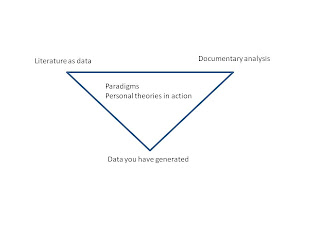 Consider many
sources, with your personal framework being central
Consider many
sources, with your personal framework being central

There are lots of different types of software and apps around now that can certainly aid the process ( as @lizith amongst others points out on #phdchat ) but does that help with developing a framework for actually using and linking your highlighted clips and references with other data? I am not sure that the following is really getting me to where I want to be. Comments welcome!
Six key
areas:
- · Outline your boundaries (e.g. just UK, just one type of school, just post 2000) but remember what one of the participants in the workshop said (Michael I think): keep your boundaries porous because sometimes something from 1948 might just be relevant!
- · Find the gaps that you want to fill
- · Write in a way which synthesises the literature (with proper attribution) rather than a list of who said what
- · Set up e-mail alerts
- · Follow up references from articles that interested you
- · Follow up citations; for example, do an internet search for an author then see who has cited them
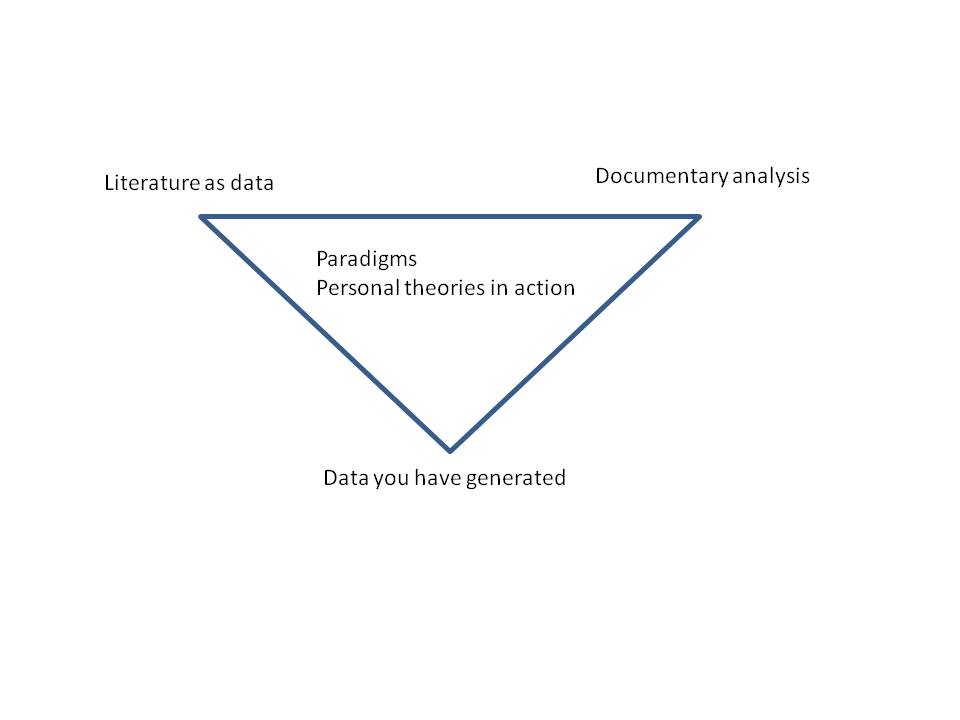 Consider many
sources, with your personal framework being central
Consider many
sources, with your personal framework being central
Remember
there is more than one type of literature review and the one you do for a
thesis will be different from one you do as a standalone piece of writing. As a
standalone, published piece of work, the review represents a product. For a
thesis, it represents a journey: signposting the reader through what you have
found and what you intend to do with that, how it links with your own work.
- · Decide if it will have a beginning, middle and ending (say what you’re going to say, say it, say what you’ve said)
- · Always state the purpose of your review
- · Give the review a personal voice as well as critical analysis rather than just description
- · Recognise different discourses in an analytic way
- · Your passion for the topic should be evident
Finally, some
thoughts I wrote a while ago that came back into my head during the workshop:-
As I could basically be said to be in the Grounded Theory 'camp' I do regard the whole process of research as potentially yielding data. Thus, one's own bias (properly described and acknowledged) becomes data ( Glaser, B. G. (2002, September). ‘Constructivist Grounded Theory?’ Forum Qualitative Sozialforschung / Forum: Qualitative Social Research. 3, 3 http://www.qualitative-research.net/fqs-texte/3-02/3-02glaser-e.htm for a much better way of explaining than I can). And I think any researcher (GT or otherwise) will wish to link their literature review to their own empirical data. But how can this be done?

There are lots of different types of software and apps around now that can certainly aid the process ( as @lizith amongst others points out on #phdchat ) but does that help with developing a framework for actually using and linking your highlighted clips and references with other data? I am not sure that the following is really getting me to where I want to be. Comments welcome!
Saturday, November 12, 2011
positivism and evidence based practice
first posted on Janshs blog Feb 2009
One of my fellow students posed the question: what is Evidence Based Practice and is it the same as positivism?
I have been wrestling with this thought for a couple of days now.
Positivists take the view that knowledge is developed by applying methods from the natural sciences – that is, that it is based on behaviour that is observable rather than on values or reasons. This means that it is based on experimental evidence or (at least) on quantitative analysis.
E891 Educational Enquiry: Study Guide prepared by Martyn Hammersley, pages 18-21:-
EBP movement began in medicine (EBM), using, for example randomized controlled trials (RCTs) which are intended to be easily replicated in other circumstances. However, even in medicine, the EBM approach may well be tempered with experiential evidence. This might also involve observation and interviewing.
So it might be appropriate to say that EBM/EBP may use evidence from a wide variety of quantitative and qualitative data but it must be valid and reliable. For EBP to affect practice, it is likely that generalisability will also be sought, although some (Schofield, 2007, Dellinger and Leech, 2007, Ely et al., 1999) might view this as being less of a necessity, provided that thick descriptions (Geertz, 1973) are used so that the reader can determine the degree of fit with her/his own context.
So I do not think that postivism and EBP equate totally, since there is an opportunity for EBP to draw on qualitative methods.
Dellinger, A. B. and leech, N. L. (2007) ‘Toward a Unified Validation Framework in Mixed Methods Research’ in Journal of Mixed Methods Research, Vol. 1, No. 4, 309-332
Ely, M., Vinz, R., Downing, M. and Anzul, M. (1999) ‘On Writing Qualitative Research: Living by Words’. London: Falmer Press
Geertz, C. (1973) The Interpretation of Cultures. New York: Basicflooks
Hammersley, M. (2007) E891 Study Guide for Open University
Schofield, J. (2007) ‘Increasing the generalizability of qualitative research’ in Hammersley, M. (ed.) Educational research and evidence-based practice. London: Sage
I have been wrestling with this thought for a couple of days now.
Positivists take the view that knowledge is developed by applying methods from the natural sciences – that is, that it is based on behaviour that is observable rather than on values or reasons. This means that it is based on experimental evidence or (at least) on quantitative analysis.
E891 Educational Enquiry: Study Guide prepared by Martyn Hammersley, pages 18-21:-
EBP movement began in medicine (EBM), using, for example randomized controlled trials (RCTs) which are intended to be easily replicated in other circumstances. However, even in medicine, the EBM approach may well be tempered with experiential evidence. This might also involve observation and interviewing.
So it might be appropriate to say that EBM/EBP may use evidence from a wide variety of quantitative and qualitative data but it must be valid and reliable. For EBP to affect practice, it is likely that generalisability will also be sought, although some (Schofield, 2007, Dellinger and Leech, 2007, Ely et al., 1999) might view this as being less of a necessity, provided that thick descriptions (Geertz, 1973) are used so that the reader can determine the degree of fit with her/his own context.
So I do not think that postivism and EBP equate totally, since there is an opportunity for EBP to draw on qualitative methods.
Dellinger, A. B. and leech, N. L. (2007) ‘Toward a Unified Validation Framework in Mixed Methods Research’ in Journal of Mixed Methods Research, Vol. 1, No. 4, 309-332
Ely, M., Vinz, R., Downing, M. and Anzul, M. (1999) ‘On Writing Qualitative Research: Living by Words’. London: Falmer Press
Geertz, C. (1973) The Interpretation of Cultures. New York: Basicflooks
Hammersley, M. (2007) E891 Study Guide for Open University
Schofield, J. (2007) ‘Increasing the generalizability of qualitative research’ in Hammersley, M. (ed.) Educational research and evidence-based practice. London: Sage
Friday, November 4, 2011
Communities of Practice
Just a few musings of me, ... I'll try to add to this later but I'm late for work!
In a community of practice (I think original idea Lave and Wenger), I would suggest that members share tacit understanding and tacit knowledge (worth looking up Polanyi) which may cross other cultural boundaries. So, for example, teachers in many countries may share similar beliefs about the nature of how people learn, or want to learn. I guess that this could be because of personality traits shared by people who join certain communities but we do also sometimes actually set out to enculturate newcomers - this might be through fairly formal means such as asking them to demonstrate evidence against a set of competences in order to 'qualify' and it can also be less formal through discussion and observation of peers.
I think this may be why #phdchat on twitter has developed as so much more than a professional or social network. There is, perhaps, a community of researchers.
"The concept of the researcher as “bricoleur” or “carpenter of her (sic) own personal theoretical constructs”, is put forward by Ely et al. (1999: 1, 4) who state that it is important to “breathe into our words the life we have experienced”. This is not to say, as Glaser emphatically states (2002: para. 9), that the researcher composes the story on behalf of the interviewees. What it does mean is that writer is attempting to express the experiences of the respondents in a way which is based on tacit, shared understandings that exist between them." (Moreland, 2007: 90)
other related blog posts
stigmergic collaboration
learning theories - is apprenticeship still valid?
The memory of social networks
Further reading
In a community of practice (I think original idea Lave and Wenger), I would suggest that members share tacit understanding and tacit knowledge (worth looking up Polanyi) which may cross other cultural boundaries. So, for example, teachers in many countries may share similar beliefs about the nature of how people learn, or want to learn. I guess that this could be because of personality traits shared by people who join certain communities but we do also sometimes actually set out to enculturate newcomers - this might be through fairly formal means such as asking them to demonstrate evidence against a set of competences in order to 'qualify' and it can also be less formal through discussion and observation of peers.
I think this may be why #phdchat on twitter has developed as so much more than a professional or social network. There is, perhaps, a community of researchers.
"The concept of the researcher as “bricoleur” or “carpenter of her (sic) own personal theoretical constructs”, is put forward by Ely et al. (1999: 1, 4) who state that it is important to “breathe into our words the life we have experienced”. This is not to say, as Glaser emphatically states (2002: para. 9), that the researcher composes the story on behalf of the interviewees. What it does mean is that writer is attempting to express the experiences of the respondents in a way which is based on tacit, shared understandings that exist between them." (Moreland, 2007: 90)
other related blog posts
stigmergic collaboration
learning theories - is apprenticeship still valid?
The memory of social networks
Further reading
Athannasiou, N. and Nigh, D. (2000) ‘Internationalization, Tacit Knowledge and the Top Management Teams of MNCs’. Journal Of International Business Studies. 31: 47-487
Lave, J. and Wenger, E. (1991) ‘Learning and Pedagogy in Communities of Practice’. In J. Leach and B. Moon (eds.) Learners and Pedagogy. London
Wednesday, November 2, 2011
phronetic research
Just some stuff I wrote in my thesis (let me know if you want refs)
Human nature is such that it is highly likely that the researcher will bring some personal theories to the start of a grounded theory study, even if these are weakly defined at this stage. Thomas and James (2006: 7) criticise the concept of GT, partly because of this issue of personal experience. Mjøset (2005: 5) is also challenging GT as a methodology. However, he pinpoints an important issue: “Grounded Theory [….] does not aim to generalize to a broader population.” The importance of the GT approach is that the situations being explored are too complex to explain using only a priori theories or hypotheses that might have been formulated before the research was undertaken and based upon generalisations from other situations. The only way that a satisfactory fit can be made between theory and actuality is by generating articulated hypotheses in context as they emerge.
Wright Mills (1959: 6) propounds the idea of a ‘sociological imagination’ to describe the link between the socio-economic background of the phenomenon being investigated and the life history of the participants in the research (the respondents and the researcher). The underlying aim of Wright Mills’ concept of the sociological imagination was to contribute to the discussion about the validity of social sciences at a time when the natural sciences were still much more highly thought of.
Anfara and Mertz (2006: xiv) cite Silver (1983) as defining theory as “a unique way of perceiving reality” leading not only to a deeper insight but also to a “fresh and different perception of an aspect of the world”.
The tacit understanding that I have as an insider researcher, coupled with the richness of the data, and alongside my approach to GT/situational analysis gives me just this kind of profound insight and leads to emergent grounded theory. Although Anfara and Mertz present a linear relationship from concepts/events to constructs (“clusters of thoughts”) to propositions (or “expressions of relationships among several constructs”) to theory ( “a ‘set’ of propositions”), the process is probably nested or looped, since the researcher may move backwards and forwards between concepts, constructs and propositions before any kind of substantive theory emerges. Even then, the emerging theory may drive the analysis back to the very beginning and start off a new loop. For Anfara and Mertz (ibid: xvii) a theory is useful if it “tells an enlightening story […] that gives new insights and broadens your understanding”.
Anfara and Mertz (ibid: xxii-xxiii) cite Cresswell (1994: 86), stating that, for him, ethnography or phenomenology involves starting with a framework whereas in grounded theory the data collection and analysis takes place before “using theory”. This is something of an oversimplification of the situation and indicates a clear cut dichotomy on theoretical stances.
Figure 3.1 (overleaf) lists Cresswell’s five ‘research traditions’ of qualitative research, along with his paradigmatic assumptions and ideological perspectives, as referred to by Anfara and Mertz (2006: xxii – xxiii).
For example, I could take 1, 2, 3, and 4 from figure 3.1, map them on to a, b, and c, and ‘underpin’ them with all of the ideological perspectives listed. This would lead to my use of narrative transcripts with my own ontology/epistemology/methodology clearly determining the constructs and propositions that I develop. My ideological perspective is such a mixture of those stated above that it would be difficult to divorce them from my whole conceptual framework.
figure 3.1 – Cresswell’s guide to a research study design

Anfara and Mertz do go on (ibid: xxiii, xxiv) to consider the work of Merriam (1998), who indicates the ways in which our framework as researchers is linked to a particular literature base and disciplinary orientation – making the whole process ‘theory laden’. They also (ibid: xxv) refer to the work of Mills (1993: 103, 144) who defined theory as an ‘analytical and interpretive framework’ which is for helping the researcher to make sense of a situation. Mills, as reported by Anfara and Mertz, perceives that there are both implicit and explicit theories “underlying” any investigation – even when a theory is “purported to be emergent”, the study will have been framed by beliefs and initial propositions.
As Anfara and Mertz write (ibid: xvii), it is the “diversity and richness” of these initial analytical frameworks that encourage researchers to “see in new and different ways what seems to be ordinary and familiar”.
Flyvbjerg (2001) takes a different view of the role of the social sciences in being able to generate theory. He asserts that there is little point in trying to generate empirical theories, such as in the natural sciences, since the very matter being subjected to investigation cannot be suitable for that approach. He bases his work on the Aristotelian division of knowledge into episteme (scientific, know why, irrefutable), techne (craft, know how) and phronesis (ethics, values, variable, context dependent). If we are investigating what is basically a value-laden human phenomenon, Flyvbjerg suggests that we should take a phronetic approach to our methodology. In such methodology, he suggests we ask the following questions (2001: 60):
1. Where are we going?
2. Is this desirable?
3. What should be done?
4. Who gains and who loses; by which mechanisms of power?
As he states, this means that there is an implicit investigation of values but he denies that this lays the approach open to criticisms of relativism since (ibid: 132) a “focus on relations of values and power” leads to interest from others than the researcher. These others will evaluate the research themselves so the phronetic researcher must deliberately assimilate the context and learn from it – without ‘going native’.
Henstrand (2006: 16) actually embraces the idea of ‘going native’, stating that “proponents of ethnomethodology” actively encourage the researcher to become involved with the group being studied in order to “understand the contextual meanings and avoid distorting the vision of the world” – here she cites Adler and Adler (1987: 32); “going native is the solution rather than the problem”.
On the topic of the richness of data and how this can lead, if not to a simple theory, then certainly to a clearer understanding of the situation, Flyvbjerg (ibid: 133) says that phronetic researchers must begin by asking “little questions” and, with patience and attention to detail, focus on Geertz’s (1973) “thick description”. Flyvbjerg would probably agree with Wright Mills: the problem with Grand Theories is that they are too general to ever be empirically observable.
Grounded theory in contemporary studies makes use of a rich array of data, building in an assimilation of contextual partiality. This potent combination allows the researcher to use the joint processes of data collection, literature search and content analysis to probe deeply into relationships and power interactions. The emerging themes and substantive hypotheses which are formed can then be used to continually develop the investigative area.
Human nature is such that it is highly likely that the researcher will bring some personal theories to the start of a grounded theory study, even if these are weakly defined at this stage. Thomas and James (2006: 7) criticise the concept of GT, partly because of this issue of personal experience. Mjøset (2005: 5) is also challenging GT as a methodology. However, he pinpoints an important issue: “Grounded Theory [….] does not aim to generalize to a broader population.” The importance of the GT approach is that the situations being explored are too complex to explain using only a priori theories or hypotheses that might have been formulated before the research was undertaken and based upon generalisations from other situations. The only way that a satisfactory fit can be made between theory and actuality is by generating articulated hypotheses in context as they emerge.
Wright Mills (1959: 6) propounds the idea of a ‘sociological imagination’ to describe the link between the socio-economic background of the phenomenon being investigated and the life history of the participants in the research (the respondents and the researcher). The underlying aim of Wright Mills’ concept of the sociological imagination was to contribute to the discussion about the validity of social sciences at a time when the natural sciences were still much more highly thought of.
Anfara and Mertz (2006: xiv) cite Silver (1983) as defining theory as “a unique way of perceiving reality” leading not only to a deeper insight but also to a “fresh and different perception of an aspect of the world”.
The tacit understanding that I have as an insider researcher, coupled with the richness of the data, and alongside my approach to GT/situational analysis gives me just this kind of profound insight and leads to emergent grounded theory. Although Anfara and Mertz present a linear relationship from concepts/events to constructs (“clusters of thoughts”) to propositions (or “expressions of relationships among several constructs”) to theory ( “a ‘set’ of propositions”), the process is probably nested or looped, since the researcher may move backwards and forwards between concepts, constructs and propositions before any kind of substantive theory emerges. Even then, the emerging theory may drive the analysis back to the very beginning and start off a new loop. For Anfara and Mertz (ibid: xvii) a theory is useful if it “tells an enlightening story […] that gives new insights and broadens your understanding”.
Anfara and Mertz (ibid: xxii-xxiii) cite Cresswell (1994: 86), stating that, for him, ethnography or phenomenology involves starting with a framework whereas in grounded theory the data collection and analysis takes place before “using theory”. This is something of an oversimplification of the situation and indicates a clear cut dichotomy on theoretical stances.
Figure 3.1 (overleaf) lists Cresswell’s five ‘research traditions’ of qualitative research, along with his paradigmatic assumptions and ideological perspectives, as referred to by Anfara and Mertz (2006: xxii – xxiii).
For example, I could take 1, 2, 3, and 4 from figure 3.1, map them on to a, b, and c, and ‘underpin’ them with all of the ideological perspectives listed. This would lead to my use of narrative transcripts with my own ontology/epistemology/methodology clearly determining the constructs and propositions that I develop. My ideological perspective is such a mixture of those stated above that it would be difficult to divorce them from my whole conceptual framework.
figure 3.1 – Cresswell’s guide to a research study design

Anfara and Mertz do go on (ibid: xxiii, xxiv) to consider the work of Merriam (1998), who indicates the ways in which our framework as researchers is linked to a particular literature base and disciplinary orientation – making the whole process ‘theory laden’. They also (ibid: xxv) refer to the work of Mills (1993: 103, 144) who defined theory as an ‘analytical and interpretive framework’ which is for helping the researcher to make sense of a situation. Mills, as reported by Anfara and Mertz, perceives that there are both implicit and explicit theories “underlying” any investigation – even when a theory is “purported to be emergent”, the study will have been framed by beliefs and initial propositions.
As Anfara and Mertz write (ibid: xvii), it is the “diversity and richness” of these initial analytical frameworks that encourage researchers to “see in new and different ways what seems to be ordinary and familiar”.
Flyvbjerg (2001) takes a different view of the role of the social sciences in being able to generate theory. He asserts that there is little point in trying to generate empirical theories, such as in the natural sciences, since the very matter being subjected to investigation cannot be suitable for that approach. He bases his work on the Aristotelian division of knowledge into episteme (scientific, know why, irrefutable), techne (craft, know how) and phronesis (ethics, values, variable, context dependent). If we are investigating what is basically a value-laden human phenomenon, Flyvbjerg suggests that we should take a phronetic approach to our methodology. In such methodology, he suggests we ask the following questions (2001: 60):
1. Where are we going?
2. Is this desirable?
3. What should be done?
4. Who gains and who loses; by which mechanisms of power?
As he states, this means that there is an implicit investigation of values but he denies that this lays the approach open to criticisms of relativism since (ibid: 132) a “focus on relations of values and power” leads to interest from others than the researcher. These others will evaluate the research themselves so the phronetic researcher must deliberately assimilate the context and learn from it – without ‘going native’.
Henstrand (2006: 16) actually embraces the idea of ‘going native’, stating that “proponents of ethnomethodology” actively encourage the researcher to become involved with the group being studied in order to “understand the contextual meanings and avoid distorting the vision of the world” – here she cites Adler and Adler (1987: 32); “going native is the solution rather than the problem”.
On the topic of the richness of data and how this can lead, if not to a simple theory, then certainly to a clearer understanding of the situation, Flyvbjerg (ibid: 133) says that phronetic researchers must begin by asking “little questions” and, with patience and attention to detail, focus on Geertz’s (1973) “thick description”. Flyvbjerg would probably agree with Wright Mills: the problem with Grand Theories is that they are too general to ever be empirically observable.
Grounded theory in contemporary studies makes use of a rich array of data, building in an assimilation of contextual partiality. This potent combination allows the researcher to use the joint processes of data collection, literature search and content analysis to probe deeply into relationships and power interactions. The emerging themes and substantive hypotheses which are formed can then be used to continually develop the investigative area.
Subscribe to:
Posts (Atom)

